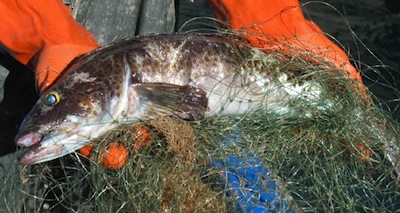
 When fishing nets are abandoned, they keep capturing fish, marine mammals and seabirds. Decaying carcasses attract more scavangers who get caught in the nets. Small fish hide in the shadow of the nets, attracting larger predators who also get caught. Modern nets don’t decompose, so they keep killing wildlife for decades or even centuries unless they are removed from the water.
The Northwest Straits Initiative pioneered the large-scale removal of derelict nets in Puget Sound, and over the last several years have removed quite a large number of them. But more remains to be done.
Finding Solutions: Derelict Fishing Gear Removal in Puget Sound from Sasha Horst on Vimeo.
This embedded video shows underwater footage of the destruction caused by the nets, and discusses various aspects of this issue. Several more videos on the Northwest Straits web site show more detail of the animals caught in the net and of the gear removal process.
Side-scan sonar has been employed successfully for finding lost gear so that it can be removed and disposed of. In order to more effectively survey for derelict nets, surveyor Crayton Fenn worked with Marine Sonic Technology® Ltd. (White Marsh, Virginia) to adapt their sonar equipment to the needs of the program. For more about this, see the article Application of Side Scan Sonar for the Detection of Derelict Fishing Gear in: Sea Technology, August 2010.