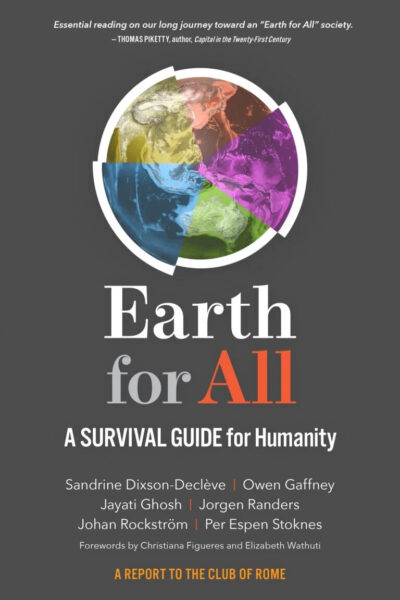
 Millions of people around the world are suffering deeply as a result of climate chaos, environmental degradation, and perverse inequality…Earth for All shows how we address these crises together, and that’s what makes it such critical reading. This is a path of possibility, infused with stubborn, urgent optimism.
That is an excerpt from the Foreword by Christiana Figueres.
Earth for All was published in 2022 as a report to The Club of Rome. As I read it, I realized that it was part of a “new wave” of literature about addressing our current global problems — a wave that was based on systems thinking.
The second Foreword, by Elizabeth Wathuti, stresses the importance of the need for this new wave:
…it seems that our world leaders do not really understand or feel the pain…They seem not to see that the system we have now is not working for most people.
Early in the book there is a list and a diagram of nine key elements of the state of the planet, and where they stand relative to tipping points — points where additional degradation would be abrupt and/or irreversible.
Later on it says, Arguably the biggest challenge in the world today is not climate change, biodiversity loss, or even a pandemic. It is our collective inability to tell fact from fiction.
And it discusses many of the issues the world is facing, looking at what will be necessary in each arena to turn things around, including: equipping girls and boys with the cognitive tools they will need to navigate this century: critical thinking, systems thinking, and adaptive leadership.
I was very encouraged to discover this book, and I think that the ideas in it will go over well with many people. As a matter of fact, I think that the book could have become quite popular, except that the writing requires some hard work to get through it. But I think that it is certainly worth ploughing through — fortunately it’s under 200 pages long.
Coincidentally, I stumbled across another important book which really does a good job of laying out in detail how systems thinking can be used to address our world problems, especially the obsolete and harmful economic models which are driving society. That book is called Doughnut Economics (by Kate Raworth) and is mentioned in Earth for All. I will do a review of Doughnut Economics when I finish reading it.