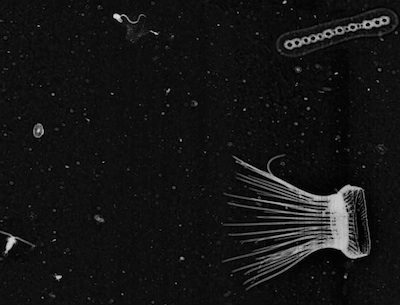
 “Imagine exploring the open ocean, diving hundreds of feet deep, and observing the unperturbed ocean and the myriad animals that inhabit this last frontier on earth—all from the comfort of your own home.” Thus begins an article in Environment Coastal & Offshore magazine. The article goes on to describe an on-line citizen science program called Plankton Portal. Plankton play key roles in the ocean food web as well as in the global ecosystem (for an overview of plankton in Puget Sound, see the movie Return of the Plankton). The Plankton Portal web site explains, “Understanding where and when plankton occur at different depths in the ocean allows scientists to get a global understanding of the function and health of the ocean from small to global scales.”
However, although collecting plankton is relatively easy, analyzing it is orders of magnitude more time consuming, so scientific progress in tracking plankton distribution has been quite slow. Enter ISIIS, an underwater robot that detects the presence of larval fish, small crustaceans, and jellyfish in ways never before possible. And while the digitally captured data can be roughly classified by computers, it takes human eyes and brains to distinguish the more subtle features. So data from this robot is classified by an army of volunteer citizen scientists.
Citizen science is not new, groups like the Audubon Society, REEF, and SETI have been using volunteer resources for quite a while. And the internet has made these kinds of distributed contributions even more practical for a variety of other kinds of projects. Zooniverse, has stepped up to make it even easier. According to their website, “The Zooniverse is home to the Internet’s largest, most popular and most successful citizen science projects.” Along related lines, Neptune Canada has created a citizen science project disguised as a game to help scientists sift through continuous video feeds from underwater observatories, and similar data streams will be coming on-line soon in the U.S., begging for other novel citizen science developments.