Review by Tara DeCoster
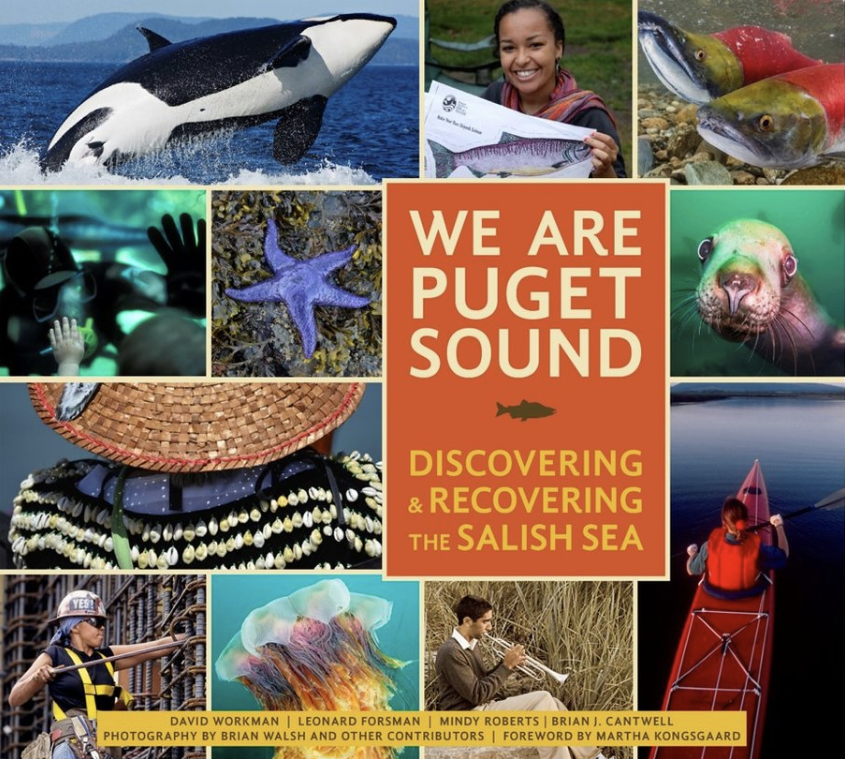
We Are Puget Sound: Discovering & Recovering the Salish Sea is very much a Call to Action. As those of us who are fortunate to live in this startlingly beautiful and wondrously sustaining part of the world are increasingly aware, our waters and the watershed that is the underpinning of our life here in the northeast corner of the Pacific Northwest are in crisis. Recent news has been full of the precipitous decline of the Southern Resident orcas and the continued concern over the health and viability of pacific salmon which led NOAA to declare 2019 the International Year of the Salmon. We know that policy changes, especially at the federal level, have significantly reduced the funding and programs available to address needs of the environment. We remember that 2020 was the year former Washington Governor Christine Gregoire targeted to achieve the recovery of Puget Sound — and with 2020 mere weeks away, recovery is still out of our reach.
But We Are Puget Sound is not a tale of gloom and doom. Far from it, it is a celebration of the ecosystem that is the Salish Sea and even more it is a celebration of us: the community of people who choose to live here. Braided River, an imprint of Mountaineers Books, has collaborated with the Washington Environmental Council to weave together history and science, people’s stories, maps and resource guides. The gloriously illustrated result places the Puget Sound firmly in our minds as it IS: what brought it to this point and what we are doing and can continue to do to repair the damage and support future growth.
There is a quote from Denis Hayes that Martha Kongsgaard has used in the past: “For those of us who know our Darwin, we understand that pessimism has no survival value.” It’s not in this book (though she generously includes the words of many others) but her powerful forward starts very much at that point, galvanizing us toward next steps to manage our “sacred obligation.”
The other contributors involved in this project continue the theme: David Workman provides the historical and scientific context, Mindy Roberts and Leonard Forsman look at the policy and action aspects, Brian Cantwell has compiled a useful and detailed list of recreational sites and Brian Walsh uses the work of several photographers to bring life to the story through the sense we all use most to enjoy the region: our eyes.
But probably the most compelling part of the book is — deliberately so, I think — the stories of our community. 15 short narratives, scattered throughout We Are Puget Sound, sound the voices of a wide range of We. Long-time residents share space with newcomers; youth with elders; tribal leaders with regional politicians and advocates; scientists with business owners and artists. They tell stories of how the past has shaped current efforts to change our labor and recreation practices and how the concept of a conservation easement has meant they can leave a legacy for those who follow. What makes these stories work is that there is optimism, drive and a sense of purpose and stewardship.
We Are Puget Sound is a book of now, of celebration, of propelling us forward and of reminder: we are a community that shares the responsibility and the honor of shaping the future of our waters and watershed, of the Salish Sea.