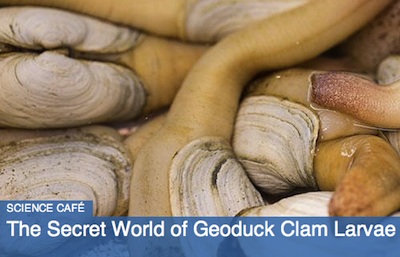
 What do geoduck do from their first moments of life until their considerable old age? How do they reproduce? Then where do they go? These were the topics of a Science Cafe presentation in February 2013 by geoduck researcher Dr. Bonnie Becker of University of Washington, Tacoma.
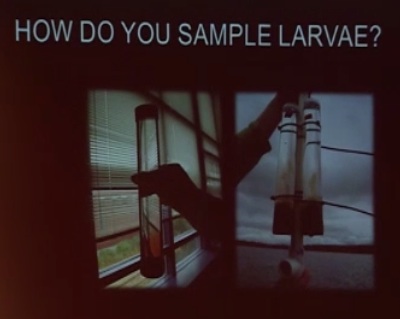
 First she established the basic life cycle of geoducks and their roles in the context of our human society, including a substantial financial component — geoducks fetch a high price in the global market. Then Dr. Becker talked about her research into some of the key things that are necessary to learn about geoducks in order to protect them, such as the movements of geoduck larvae around Puget Sound and the relationships between different geoduck populations.
Science Café events bring local scientists face-to-face with the general public at T.S. McHugh’s in Seattle, Wilde Rover in Kirkland, and The Swiss Pub in Tacoma. All Science Café events are free to the public, open to all ages, and no science background is required. Science Cafés are presented in partnership with Pacific Science Center. They are filmed by PBS station KCTS of Seattle, and Science Cafés dating as far back as 2008 are available for viewing on the KCTS web site.