The International Marine Conservation Congress (May 14-18, 2011 in Victoria BC) distinguished itself by incorporating art into the long days of technical talks by scientists. I reported earlier on a beautiful and moving song by a 10 year old who performed at the conference.
A tall totem pole, a permanent part of the conference center dominated the foyer. But the lion’s share of artistic diversity lay in the many ocean related photographs and paintings. “Those of us who spend most of our time on land don’t often get to experience life underwater,” said exhibition curator and artist Robi Smith. “This show is an amazing opportunity for the artists to share their passion for the ocean with scientists and others who are working to protect marine ecosystems, including our own here in BC. We would love to inspire the public to learn more about the fascinating creatures who live in our waters.” Artists whose work was featured in the exhibition are:
- Vicky Bowes (Vancouver, BC), painting
- Kirsten Chursinoff (Vancouver, BC), textiles
- Anne Hansen (Victoria, BC), painting
- Leanne Hodges (Quadra Island, BC), painting
- Ian McAllister (Great Bear Rainforest, BC), photography
- Cam MacDonald (Duncan, BC), drawing
- Robi Smith (Vancouver, BC), mixed media
I had the pleasure of interviewing three of these artists. They all showed a high level of awareness of not just the visual aspects of their subjects, but of the relationships that exist between us and the water around us.
Watch for a short video about them in a future episode of the TV series SEA-Inside: Pacific Northwest.
Until then, here is a little bit about the artists and their art.
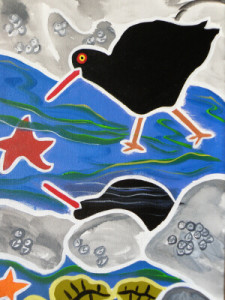
Anne Hansen (http://oystercatchergirl.blogspot.com) is in the throes of a love affair with oystercatchers along BC’s west coast. Despite growing up in Ontario, far from any ocean, she paints them rapturously among colourful seaweeds, tidepools, and log-strewn beaches. Having recently completed her two hundred and fifty-seventh oyster catcher painting , Anne says, “I’m equally enamored with oystercatcher habitat as I am with the birds themselves — out of context they wouldn’t be their oystercatcher selves.”
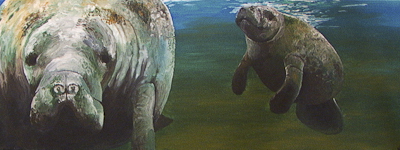 Vicky Bowes (http://oceanroots.org) captures the evolutionary perfection and grace of species in their natural environment.
She shows the immense diversity that lies beneath the surface of the world’s oceans. “I’m just amazed by everything in the ocean, so it’s not very difficult to find inspiration.” She apparently doesn’t have any trouble conveying inspiration either. Her paintings express a realism that grabs the viewer by the lapels, juxtaposed with large shares of emotion and complexity. The jellyfish at the top is Vicky’s too.

Robi Smith (www.blue-lantern.ca/studio) “…there is so much that artists and scientists have in common in terms of observation, of interest in the natural world, of thinking about our place as humans on this planet and how we relate to the natural world…” Robi’s paintings depict the beauty and mystery of local marine species while subtly and symbolically representing the ocean as threatened by pollution, over fishing, and climate change. All of the fish in her paintings have, at one time or another, swum through BC’s coastal waters.