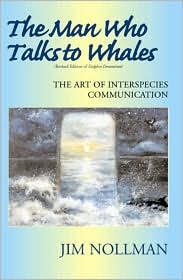
 Every summer for decades, Jim Nollman played music with the same pod of orcas. His book, formerly published as Dolphin Dreamtime, chronicles his exploration of the interspecies language of music as he improvised melodies with buffalo, mosquitos, elk, turkeys, monkeys, dolphins, and with various kinds of whales. “With” is an important word here. Nollman wasn’t attempting to follow the path of scientists who see animals as specimens to be studied. He wasn’t performing communication experiments on animals in a laboratory or an aquarium. Instead, he explored communication with the animals as willing participants in their own habitats. He interspersed his sounds with theirs, overlapping his culture with theirs, to see what could be learned.
Rather than following the scientific method of using these experiences to prove or disprove a theory about communication, Nollman sidestepped science and dove into the heart of the philosophical question “what is knowledge?” Rather than working with long strings of theoretical words, he approached the question with the strings of his guitar, interacting with animals in the context of specific aspects of that question: what are music and communication in an interspecies sense?
It’s no coincidence that my recent re-reading of Another Roadside Attraction by Tom Robins made me think of Jim Nollman’s musings. While Robins’ book explored some of the far reaches of cultural philosophy, it’s not an attempt at documenting answers, but an exercise in raising questions much as Nollman has. While Robins created linguistic art and cerebral stretching with metaphor and metaphysics, Nollman engaged in real life experiences to dig into metacognitive awareness and meta-meta-communication.
When I was in college, I worked in a psychology laboratory putting rats through a maze. I dressed in a white lab coat every day and treated each rat exactly the same way as every other rat. That helped reduce the number of variables, so the experiment could uncover some “average” rat-ness. Nollman sidestepped the notion of a scientifically average orca and brilliantly demonstrated his grasp of the diversity within societies and even in families when his questioning of orca music led him to observe: “…the process is never merely a collaboration between orcas and humans. Perhaps more important still is the matter that here are two individuals, beyond the confines of species, environment, and history. Maybe only one in every five orcas possesses a musical imagination.”
The Man Who Talks to Whales challenges us to reconsider the way we think about and relate to the animals with whom we share the world. Nollman’s writing conveys his joy and sense of brotherhood in these exploratory encounters.
Jim Nollman has written other books including The Charged Border (1999) and The Beluga Café (2002), neither of which I’ve read. If you have read one of these and would like to write a review for the SEA-Media web site, send it to us using the form under Participate on sea-media.org.