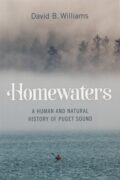
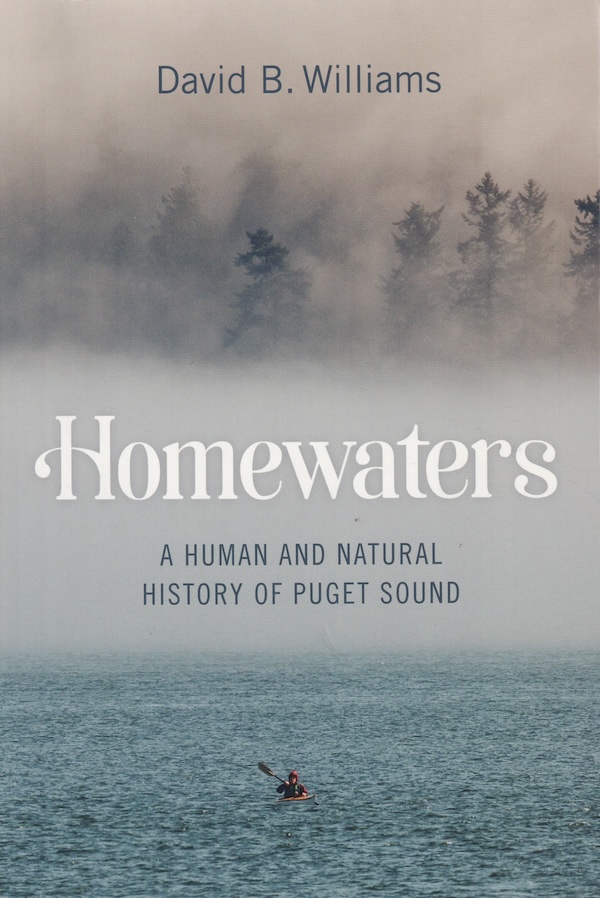
 Homewaters
For years I have been seeking out resources which depicted nature more as a “system”, an ecosystem, than as a list of species or a hierarchical food chain. I was delighted to discover that Homewaters by David B. Williams did an exceptionally good job of that.
His story-telling style is easy and interesting to follow, each chapter revealing a different dimension of the interactions between aspects of the Puget Sound ecosystem and the variety of ways humans have impacted it.
I was especially thrilled with his “Forests in the Sound” chapter, as I have spent many very memorable times in kelp forests. David did a great job of conveying the visual impact of the kelp forest, and he described a variety of its physical activities, such as limiting wave action as well as impacting sedimentation rates and coastal erosion.
But, of course, the kelp forests are also a home for a rich diversity of life, and he lists quite a few inhabitants including urchins, bacteria, abalones, pillbugs, mussels, sea stars, kelp crabs, sand lance, herring, tubesnouts, orca, and salmon. And I will never forget seeing a dogfish shark swim past me in a kelp forest, or the rockfish which seemed to like hanging out there.
He also did a great job of conveying the relationships between the marine world and the local land. Two such examples are his descriptions of the beach wrack ecosystem and the indigenous relationships with the marine life.
I have only touched on a small part of the richness of this book, and I highly recommend Homewaters — for the way it introduces the components of the Puget Sound ecosystem, but especially for how it weaves the various parts together.