 Preserving and restoring nature are key items on our global agenda. But it’s complicated. What do we preserve? What are the goal posts for our restoration efforts?
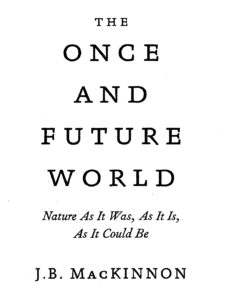
J.B. MacKinnon takes a hard look at these issues and at getting one’s mind around nature in general. His 2013 book, The Once and Future World, is written to be fairly easy to read, and he blends personal experiences and insights with a review of the science relevant to his discussion.
As a youth, he saw the red fox, who made dens on his local prairie, as his boyhood symbol of wild nature. But he left home after high school, and returning home after an absence he found that much of the prairie had been turned into a housing development. Gone were the fox dens.
This shocking change was made even more complex by his discovery that the red fox had only been in that area for a few decades before he discovered them — they were an invasive species.
This is just one small example of MacKinnon’s theme that to make sense of nature, one needs to look back at the past — not just the recent past, but hundreds or even thousands of years ago. And if we want to restore nature to “normal” we need to take a hard look at what we mean by “normal,” since the baseline seems to shift as each generation grows up seeing something different.
MacKinnon examines many aspects of how our target “normal” should be defined. I thought it was especially telling that he used a feedback loop to describe our diminishing awareness of nature. In the context of a majority of people living in cities, he said:
“In the city, we tend to not pay much attention to nature…With nature out of focus, it becomes easier to overlook its decline. Then, as the richness and abundance of other species fade from land and sea, nature as a whole becomes less interesting — making it even less likely we will pay attention to it.”
This is something I had noticed but had been unable to put into words. And some of my affection for his description is because I am partial to the concept of feedback loops. They are incredibly useful tools for expressing dynamic relationships between parts of the ecosystem.
So it really got my attention when he described another feedback loop, this time a more optimistic one:
“Pay attention, and we will value nature more. When we value nature more, we work harder to reverse its declines. Reverse the decline in variety and abundance, and nature becomes steadily more fascinating, more spectacular, more meaningful.”
Wow! That sounds a lot like the mission of our Salish Magazine! I will have to add that to our magazine description on our website.
MacKinnon said something else that embraced another of my areas of interest. We have evolved to be primarily terrestrial animals, and we have dramatically changed the land. So much so, he said, that our best hope to understand nature, without the human imprint, is to look at the sea.
Again, that is aligned with SEA-Media’s mission: to learn from the sea. Coincidentally, I also happen to be reading a recently published book that chronicles many of the explorations of the deep ocean — a region named after Hades, and which for hundreds (if not thousands) of years was generally thought to be devoid of life. The author, Susan Casey, offers stories of deep ventures which show that assumption is not just untrue, but it is a dramatic underestimation of the extent of our ecosystem. I will write a review of that book, “The Underworld,” at some future date.
But it is very heartening to me that I have been discovering publications which, especially in the last 10 years or so, have been giving more and more attention to careful looks at our earth’s ecosystem.